
Columbia City Directory Collections
A Columbia city directory search runs into one limit early. No public catalog lists a standalone printed Columbia run. It names no publisher. It gives no first and last years. The hunt is far from empty, though. The Maryland State Archives directory series documents regional volumes. Those volumes reach Howard County before Columbia opened. That still leaves strong places to look. HCLS, the Howard County Historical Society, and Columbia Archives can check a local telephone book. They can also check a reverse directory, obituary index, or village material. Note the volume title and its coverage area in every Columbia research note.
| Collection | Years | Where held | Access |
|---|---|---|---|
| Polk's Baltimore City Directory | 1956 | Maryland State Archives directory guide | Guide record, Baltimore-focused context |
| Polk's Baltimore City Directory, Anne Arundel, Baltimore and Howard Counties | 1958 | Maryland State Archives directory guide | Regional Columbia-area and Howard County proxy |
| Baltimore Suburban Directory | 1959 and 1963 | Maryland State Archives directory series | Regional address and name tracing |
| Baltimore City Directory | 1964 | Maryland State Archives directory guide | Regional urban context, not a Columbia run |
Directory dates in these series are catalog entries. They are not a promise that a given Columbia address appears in them. A shelf check settles exact local holdings, reverse sections, telephone-book years, and obituary-index dates. Start online with the Archives guide. Then move to the library, the historical society, or an archive appointment. Do this if the catalog result runs thin.
1958 Columbia Directory Proxy
For pre-Columbia research, one regional volume does heavy lifting. The 1958 Polk directory covered Anne Arundel, Baltimore, and Howard Counties together. It stands as the strongest official proxy for the years before the planned community. The Archives guide spells out what such volumes held. Entries ran alphabetical for private citizens and businesses, with addresses. A street or avenue guide mapped the roads. Postal-zone tables and other compact reference matter filled out the pages. That mix can anchor a lead when a family name or tract predates the community itself. Handle the regional scope with care, though. Columbia opened in 1967. A 1958 entry documents the surrounding Howard County area rather than a later Columbia resident. Record the county and publication title beside the name. Then test the result against a deed, census record, obituary, or archive finding aid. Common surnames and renamed roads trip people up. Note: A regional directory can supply a useful historical lead. It does not prove residence at a later Columbia address.
Columbia Directory Shelves at HCLS
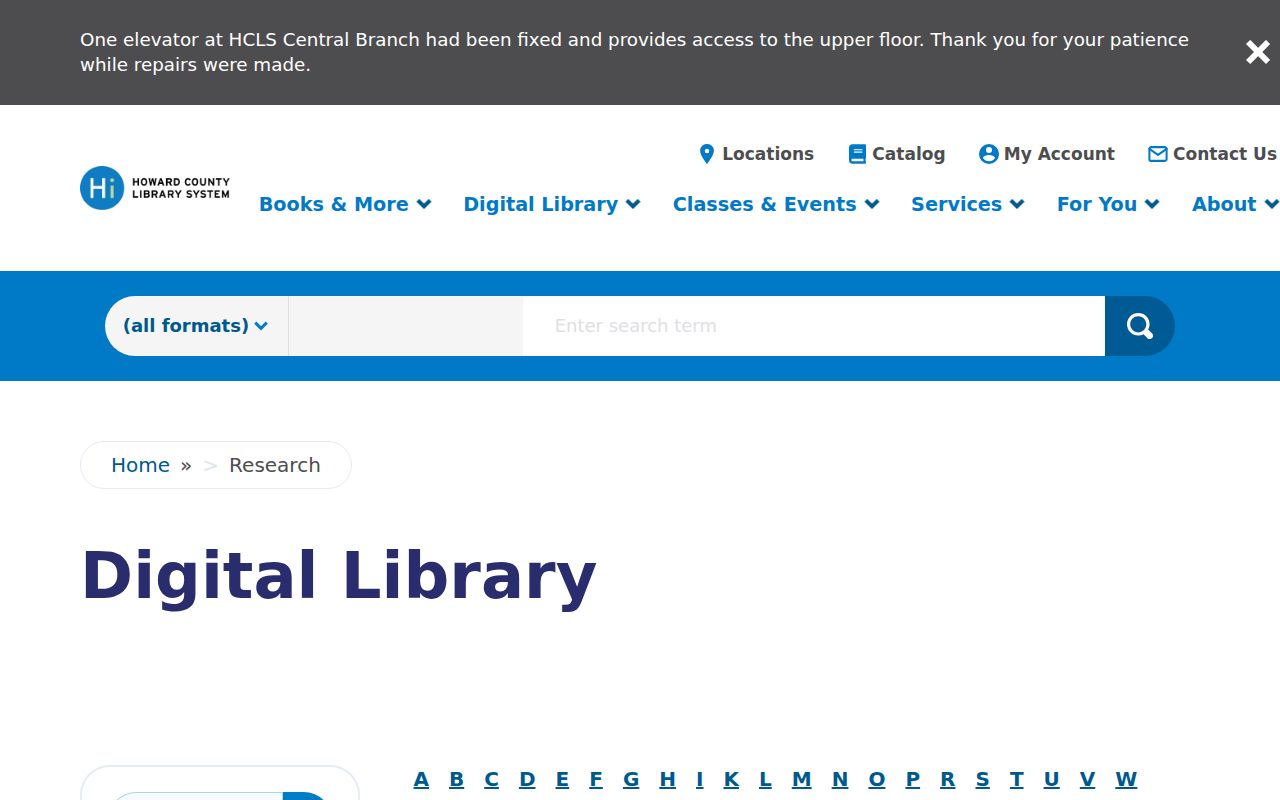
Some Columbia directory questions outrun the state guide. The Howard County Library System's History and Genealogy research gateway is the practical first stop for those. HCLS Central Library is easy to reach. It sits at 10375 Little Patuxent Parkway in Columbia. Hours run Monday through Thursday 9 to 8, Friday and Saturday 9 to 5, and Sunday 1 to 5. Staff can check a lot. Ask them about Columbia non-circulating reference shelves, microfilm, obituary indexes, yearbooks, telephone directories, and any reverse or criss-cross volumes. The official HCLS research gateway page is the place to start online.
The Columbia library gateway turns a broad surname search into a catalog request. It can also lead to a staff-assisted local-history check. Start with HCLS's Streets subject catalog. Its keyword, search-by, limit-by, and more-search controls pair with facets. The facets cover Streets, City and town life, Neighborhoods, and Columbia Archives. Try terms like Columbia Maryland, Howard County directory, telephone directory, criss-cross, reverse directory, obituary, yearbook, or village. Add a street name too. A catalog entry marks a lead. It is not always a name-level index.
An onsite question still matters. HCLS does not publish a complete Columbia shelf list showing directory years or reverse-volume coverage. So ask which Columbia branch holds the item. Ask whether it circulates or sits in a non-circulating case. Also ask whether it is a book, microfilm, or catalog reference. Bring name variants, an old street spelling, and an approximate year. Those details help staff tell a regional volume apart from Columbia-specific community material. They get you to the right residents directory faster.
Columbia Archives and Directory Context
A traditional residents directory is only one historical layer in Columbia. The Columbia Association Archives holds planned-community records and community-organization files. It also keeps oral histories, ephemera, photographs, and place-name material. It sits at 6310 Hillside Court, Suite 100, Columbia. Appointments run Monday through Thursday from 10 to 4. Archivists can supply scans or photocopies. For tracing a resident's tie to a village group, event, or organization, this is the strongest Columbia-specific source around.
Also nearby: the Howard County Historical Society Archives Center.
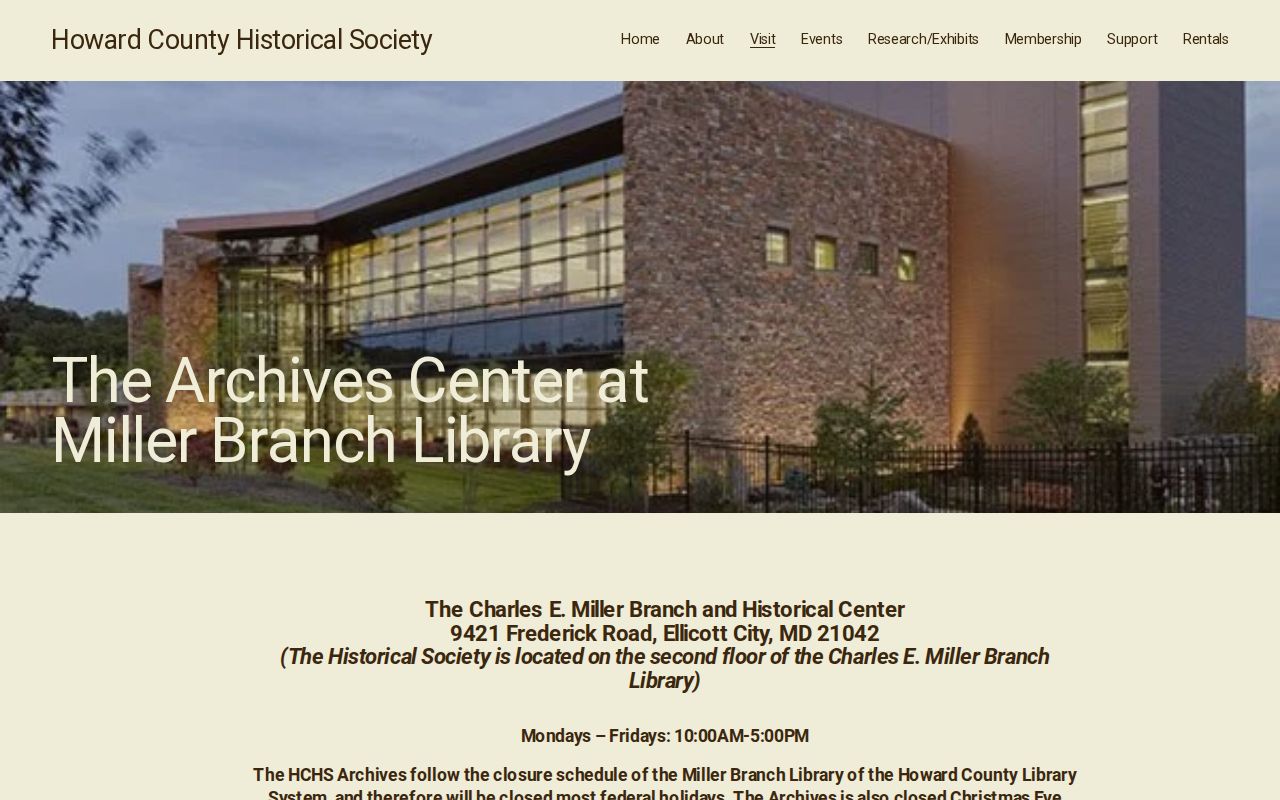
The historical society holds far more than directories. Its collections span Columbia and countywide maps, deeds, photographs, marriage material, cemetery and church records, obituaries, and family collections that can test any directory lead from another angle.
For a name tied to a Columbia organization, search the organization itself first. Next come its newsletters or minutes. Only then try the person's name. A finding aid may reveal officers or event names, but it never yields a complete household list. The public Columbia Maryland Archives database offers another search route, and appointments still matter for material that has not been digitized.
The HCHS Research Library sits on the second floor of Miller Branch Library at 9421 Frederick Road in Ellicott City. Appointments are encouraged. The archives and library are free to use and non-lending, covering maps, deeds, prints, photographs, marriage material, cemetery sources, and family collections. Hours run Monday through Friday from 10 to 5. A small xerox fee applies.
Read a Columbia City Directory Entry
Classic Columbia entries from this era are hard to come by. The clearest model for format is an 1858 Baltimore directory page. It was digitized by the Library of Congress. Treat it as a proxy only. The entry order stays compact. A surname comes first, then a given name or initials. A professional or affiliation descriptor follows, and then a street address, and a dwelling or location notation. Before expanding a Columbia name elsewhere, copy the punctuation, abbreviation, page, and volume title exactly.
| Name | Alphabetical surname followed by given name or initials |
|---|---|
| Descriptor | A professional, affiliation, or business description when printed |
| Address | Street, number, business location, or residence clue |
| Dwelling notation | A compact location note that should be checked in another record |
| Page evidence | Volume title, year, page, and the exact abbreviation used |
Short entries omit people. One listed householder is not every resident, lodger, or child at that Columbia address. Always compare spelling, address, and descriptor first. Match them against another year or record before connecting two results.
- Criss-cross directory
- A reverse section arranged by street address, used to move from a known address toward a named occupant or householder.
- Householder index
- An alphabetical or address-based list that identifies the person used as the household reference, not necessarily everyone present.
- Abbreviation key
- The volume's explanation of shortened terms. Photograph or copy it before interpreting an unfamiliar listing.
Columbia Dates Behind Directories
Columbia's record story spans several dates, not one directory era. Howard County land-record series begin in 1851. The latest released federal census is 1950. Columbia opened as a planned community in 1967. HCLS Central Library followed in 1981, and the Columbia Archives public searchable database launched in 2020. That sequence explains why an early household may appear under Howard County or an older place name before community records become useful.
| Date | Record context |
|---|---|
| 1851 | Howard Circuit Court land-record series begins |
| 1950 | Latest released federal census in the research window |
| 1967 | Columbia opens as a planned community |
| 1981 | Central Library opens in Columbia |
| 2020 | Columbia Archives launches its first fully public searchable database |
For pre-1967 Columbia research, skip the modern label. Use Howard County enumeration districts and land or tract references instead. The Maryland State Archives chronology supplies the county and community milestones in one timeline. Note: A modern Columbia label may not appear in an older directory. It may also be missing from a census record.
Columbia City Directories by Address
A known historic address changes the search. Ask HCLS or HCHS whether a local reverse or criss-cross volume exists for that year. That shelf is not published online, so confirm before relying on it. If one exists, use the address section to pull the named occupant or householder. Then check the alphabetical section. It adds the fuller abbreviation and any second address. Nearby Columbia street entries are context only. They never prove the same people formed one household.
Street names add their own traps. The Columbia Association notes that many local names draw on literature and art. Satan Wood became Satinwood Drive. Search both Columbia forms when the era calls for it. Then bridge the result with a plat, deed legal description, older map, or archive catalog.
For current parcel-by-address work, the Columbia street directory covers the modern county record chain. It keeps that chain separate from this historical shelf. The HCLS streets catalog lists street holdings by subject. Its facets let you test a street name, neighborhood, or Columbia Archives subject. Do that before an onsite visit.
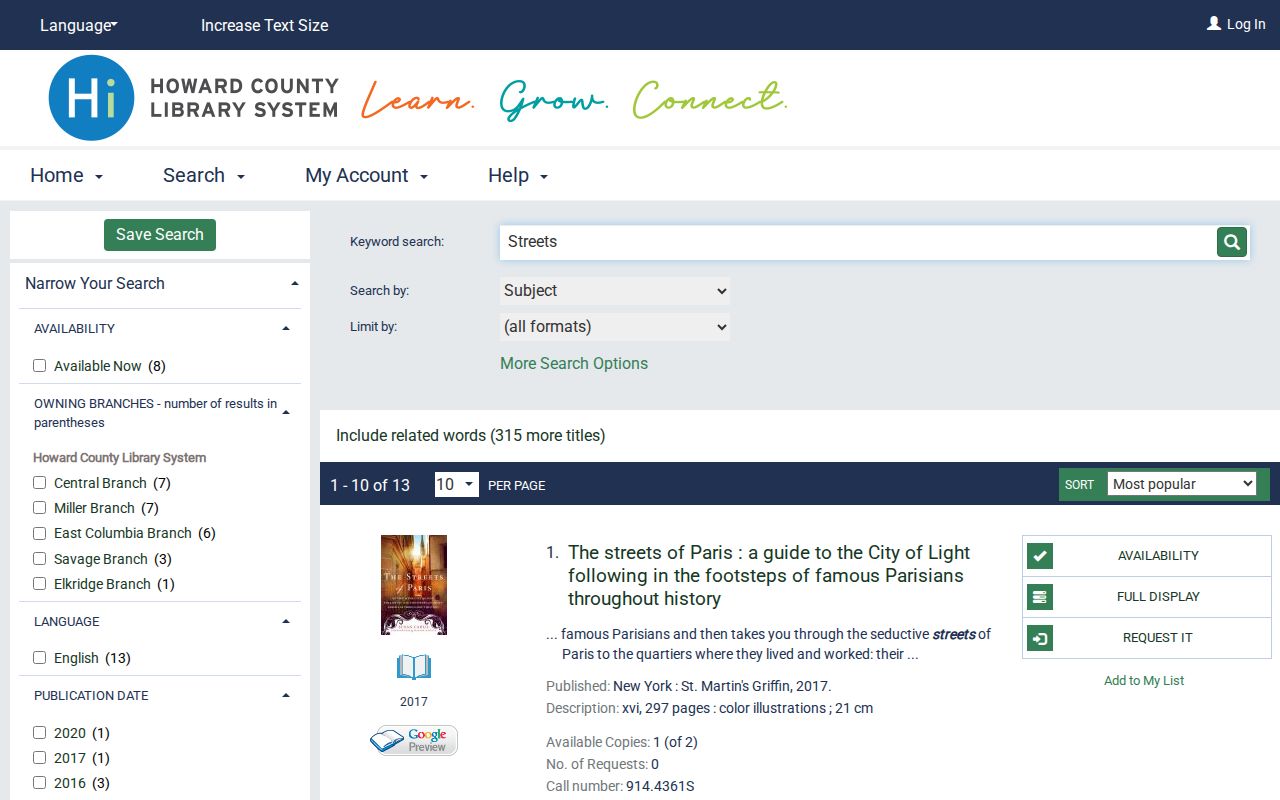
The catalog facets offer a practical test. Use them to check a street name, neighborhood, or Columbia Archives subject before arranging an onsite visit.
Trace Columbia Directory Households
A careful Columbia directory trail follows one household across time. One listing is never the conclusion. Begin with the earliest solid appearance in a regional or local volume. Preserve the exact spelling and address. Then search both the preceding and following years. Pair each result with a census, deed, obituary, cemetery record, or archive finding aid; the National Archives census access page confirms that federal census records through 1950 are released under the 72-year rule.
- Search the alphabetical listing for the surname and sensible spelling variants, then note the year, page, descriptor, and address.
- Check the next and prior directory years or cataloged volumes to separate a move from a one-year omission.
- Use a confirmed reverse section, if HCLS or HCHS identifies one, to connect the address to the listed householder.
- Pair the directory year with the nearest released census, a Howard County deed, or a dated obituary to test the identity.
- For planned-community activity, search Columbia Archives by organization, village, event, or street-name term before relying on a personal-name hit.
A disappearance can mean several things. It might signal a move, a death, an unlisted household member, a changed street label, or a gap in the volume. Stop when the evidence turns ambiguous. HCHS offers historical business, house, and property research at $25 per hour, with the first 30 minutes free for nonmembers. Copies or scans cost extra, mailed printed forms are accepted, and a response arrives within six weeks. That documented service beats any same-name guess.